
Visceral fat: what it is, why waist size matters and what helps
Someone asks how to lose visceral fat fast, and the replies fill up with advice. It's a fair question, but "fast" is where most of the confusion starts. Visceral fat is not the soft layer you can pinch. It sits deeper, and a tape measure tells you more about it than the bathroom scales do.
Here is what visceral fat is, how to check your own waist in a minute, what helps over time, and how the Thrive Health Band and app show your body composition and daily habits right across your health, so you can follow progress without fixating on one number.
What visceral fat is
healthdirect describes visceral fat, which it calls excess internal body fat, as fat stored around your organs, including your heart, liver and intestines. A small amount is normal and helps cushion them. Most of your fat sits under the skin, which is the fat you can see and feel.
The same page explains that a larger amount of visceral fat is linked with higher chances of health issues, including high blood pressure, heart conditions and type 2 diabetes. That is a reason to take a steady, relaxed interest in your waist, not a reason to panic. It builds slowly, it responds to everyday habits, and a health professional can help you make sense of your own numbers.
Why a tape measure is the everyday check
You can't see visceral fat from the outside, and scales can't tell it apart from other weight. The Department of Health says waist size is a practical guide, because a larger waist suggests more fat deposits deep inside the belly.
- Men: 94 cm or more is a higher level, and 102 cm or more is higher again.
- Women: 80 cm or more is a higher level, and 88 cm or more is higher again.
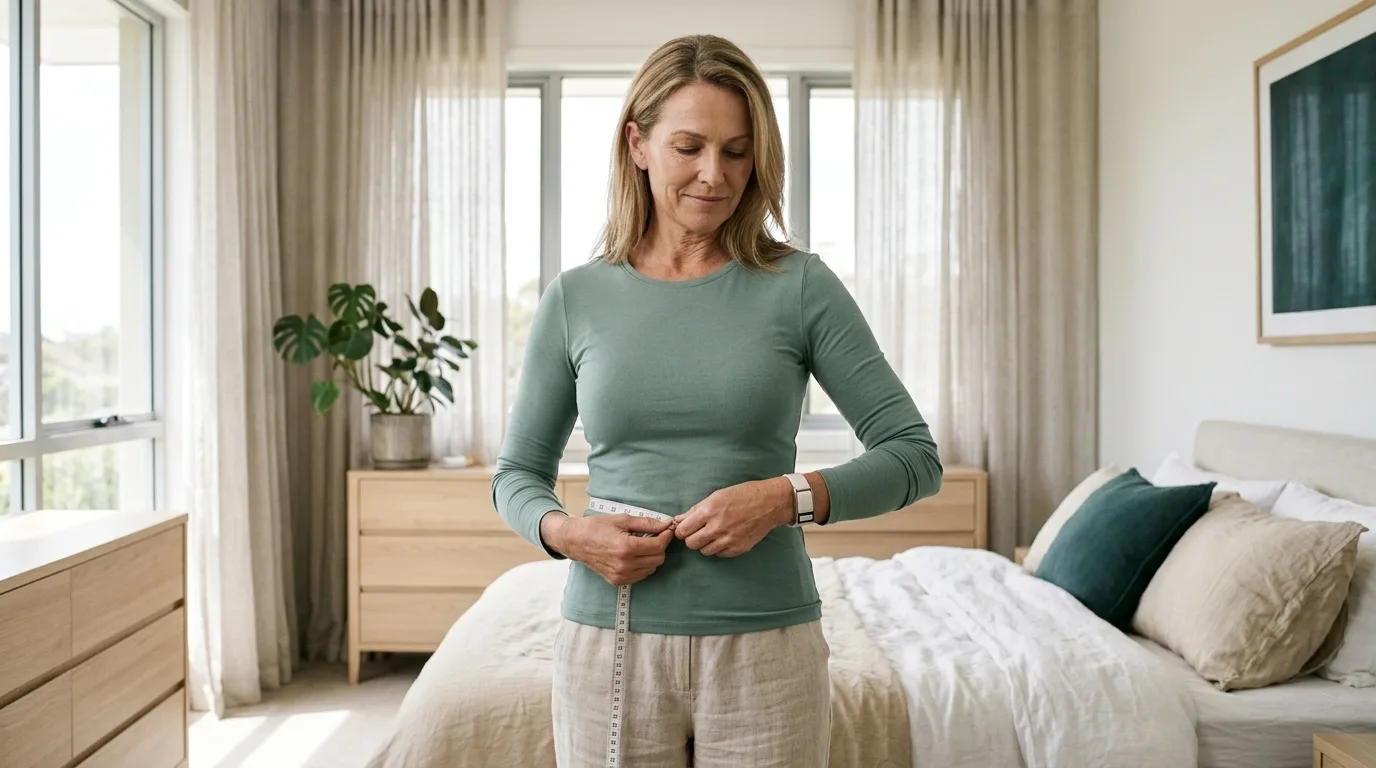
To measure, loosen your belt and stand with your feet shoulder-width apart. Wrap a tape measure around your belly in line with your belly button, loose enough to fit one finger inside the tape. These figures don't apply to children or to anyone who is pregnant, and a measurement is one piece of information, not a verdict. Muscle, build and background all matter, so your GP is the best person to read your result.
What helps over time
healthdirect says the best way to reduce excess internal body fat is through weight loss, and that regular exercise is especially effective at reducing it and keeping it from coming back. Its everyday suggestions are simple:
- Move most days. Aim for at least 30 minutes of physical activity on most days. Walking counts. Our guide to how many steps a day you need puts the numbers in perspective.
- Eat a balanced diet. Plenty of vegetables, whole grains and lean protein, and fewer sugary drinks.
- Go easy on alcohol. healthdirect suggests cutting back on sugary drinks and alcohol.
- Sleep enough. Sleep is on healthdirect's list too. Our guide to how much sleep adults need is a good starting point.
Keep your muscle while you do it. Our articles on losing fat and keeping muscle and health beyond the scale explain why the scales alone can mislead.
Why "fast" is the wrong goal
Fast plans tend to be hard to keep, and they often cost you muscle along with fat. A slower approach works with the way your body actually changes: a few more walks, a few more vegetables, a few better nights. The change that sticks is usually the smallest one. Pick a single habit this week, give it a few weeks, and let the trend, not any one day, tell you how it's going. If thinking about your waist makes you anxious, you're not alone, and it's fine to check just once a month.
How Thrive helps you keep track
The Thrive Health Band is screen-free, so you wear it day and night while the Thrive by Optihealth app joins up the pieces. For this topic that means:
- Body composition estimates. Take a reading using the electrode on the Band to see estimated body fat, muscle and body water trends over weeks, with no scale to step on. Our guide to body fat percentage and body composition explains the numbers.
- Waist and other measurements. Log your waist in the app's Body measurements screen, using the digital tape or by typing in centimetres, and watch it over months rather than days.
- Activity and sleep. Steps, active minutes and your sleep Quality, Quantity, Regularity and Timing sit side by side, so you can see which weeks went well.
- Food. Log meals with a photo, a barcode scan or a search of Australian foods, and see calories and protein against your goals.
- Ask Thrive. Try "How has my body fat trend changed since I started walking most days?" or "What changed in my sleep and activity over the last month?"
Over time your Thrive app builds a picture of what's usual for you, and your Health Fingerprint is ready after about 30 days of wear. Thrive isn't a diagnosis, and it doesn't replace a health professional. But you can show your Thrive trends to your GP, and a few months of waist, body composition, activity and sleep make a better conversation than a single reading.
When to talk to your GP
If your waist measurement is above the figures, or you're worried about your weight, blood pressure, blood sugar or family history, a GP visit is a sensible next step. Most GPs are glad to see you early. Bring your waist measurements, your recent body composition trends and a note of what you've changed.
Before you buy
- Thrive Health Band: A\$589 for the band including 12 months of the Thrive plan, paid upfront. Prices are in AUD and include GST.
- Free shipping. Your 12 months start when you activate your Band.
- One size, IP68, up to 14 days battery, 12-month warranty, no Apple Health sync. The app is Thrive by Optihealth on iPhone and Android.
- See today's price on the Thrive store
At renewal: a new band plus 12 more months for A\$589.
Or keep your band and renew the plan for A\$240 a year.
Or A\$29 a month with no lock-in.
Consumer guarantees under Australian Consumer Law always apply. See Returns if something is wrong with your purchase.
Common questions
Can you spot-reduce belly fat?
healthdirect points to overall weight loss, regular exercise, a balanced diet and enough sleep, not one exercise or drink aimed at the belly.
What waist size is healthy?
The Department of Health says 94 cm or more for men and 80 cm or more for women is a higher level. These figures don't apply to children or pregnant women, and your GP can put your result in context.
Can the Thrive Health Band show my body composition?
Yes. Take a reading using the electrode on the Band to see estimated body fat, muscle and body water trends, and you can log your waist in the app.
For more answers, see Questions.
Your next step
Measure your waist this week, log it in the Thrive app, and put one short walk in the diary for tomorrow.
Sources
- healthdirect, How to reduce excess internal body fat (visceral fat): https\://www.healthdirect.gov.au/how-to-reduce-excess-internal-body-fat-visceral-fat
- Australian Government Department of Health, BMI and waist measurement: https\://www.health.gov.au/topics/overweight-and-obesity/bmi-and-waist
- X trending story (visceral fat meme, 4 Nov): https\://x.com/i/trending/2118035838089187680
- World Diabetes Day 2026 theme (TDC Australia): https\://tdcaustralia.com.au/worlddiabetesday2026/
- Google Play, Thrive by Optihealth (read 9 Nov 2026, Brisbane; listing updated 30 Oct 2026): https\://play.google.com/store/apps/details?id=com.sensacare.app
- Australian App Store, Thrive by Optihealth (read 9 Nov 2026, Brisbane): https\://apps.apple.com/au/app/thrive-by-optihealth/id6759827776