
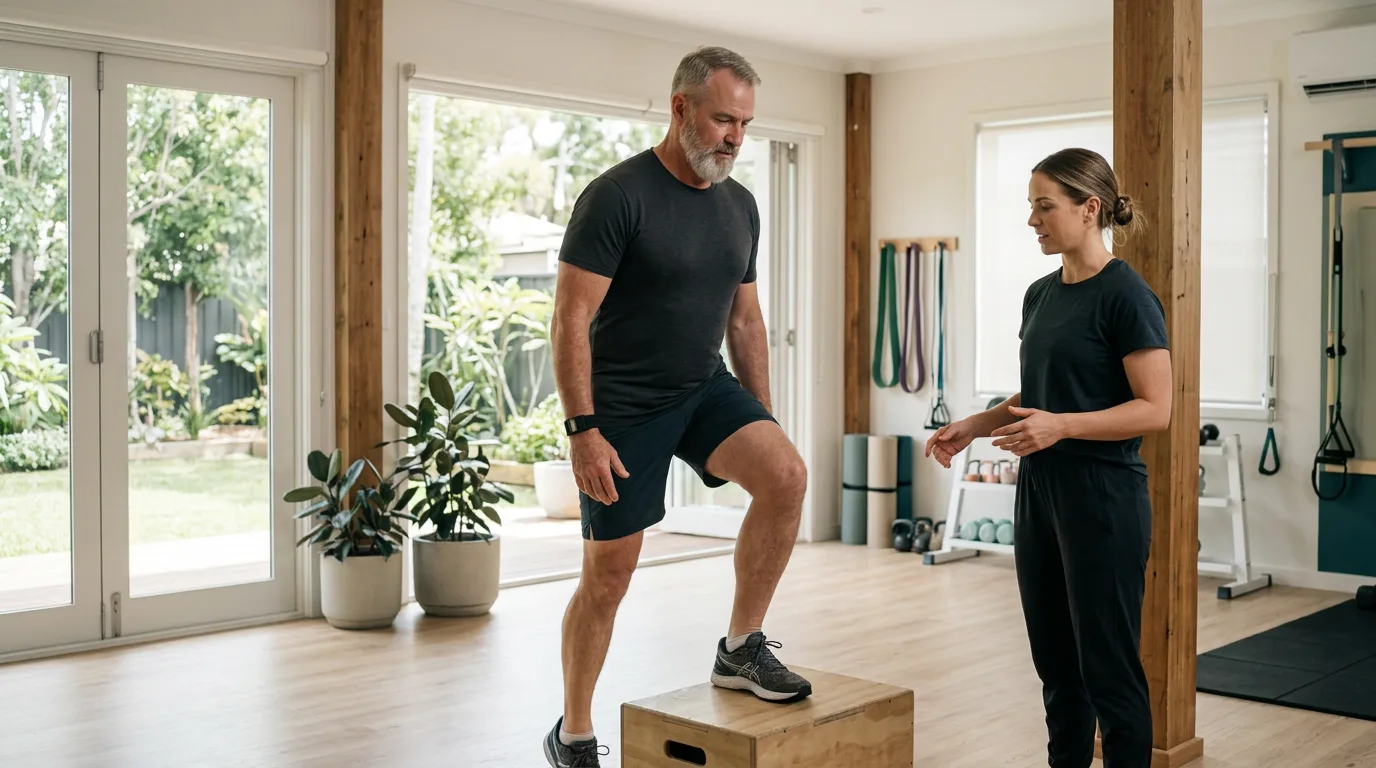
Staying strong through midlife: muscle, balance and pre-frailty in your 40s and 50s
Frailty sounds like something for much later in life. But a 2020 Flinders University study, featured in the Sydney Morning Herald in October, found early signs in people far younger than you might expect.
The short answer: pre-frailty means small early signs, such as weaker legs, poorer balance or a softer grip, that can come before frailty. Flinders University researchers found it in 45% of the people aged 40 to 49 in their study, about the same share as people aged 70 to 75 (39% across everyone aged 40 to 75). The encouraging part is that the researchers found many of these signs can change. Regular strength and balance work, enough protein and staying connected with people all help, and it's never too early to start.
What is pre-frailty?
Frailty is when the body has less in reserve, so everyday knocks like an illness or a fall are harder to bounce back from. Pre-frailty is the stage before that.
In the Flinders study, published in BMC Geriatrics, researchers assessed 656 people aged 40 to 75 in Adelaide. Signs linked with moving towards pre-frailty included lower leg strength, trunk stability, balance and lean muscle mass. The researchers concluded that support could start in people's 40s.
Pre-frailty isn't a diagnosis you can give yourself, and it doesn't mean something is wrong. Think of it as an early nudge to look after your strength.
Muscle loss and sarcopenia in your 40s and 50s
You don't need to feel weak for this to matter. Healthdirect says muscle mass starts to drop slowly from around 30 and more quickly after 50, and that women can lose muscle more quickly with menopause.
When muscle loss leads to real weakness and makes physical tasks harder, it's called sarcopenia. Healthdirect says that if you feel you're losing strength, don't assume it's just part of getting older: see your doctor for a check-up.
The good news is that muscle responds to use. The Better Health Channel notes that older people can build muscle mass and strength through muscle-strengthening activities.
Why grip strength comes up so often
Grip strength is one of the simple checks doctors use. Healthdirect lists a hand-held grip test, standing up from a chair without using your arms, and timing your walking among the tests your doctor may use to look at muscle loss.
You don't need to test yourself at home. If you notice jars are harder to open or shopping bags feel heavier than they used to, mention it to your GP.
Balance exercises and strength: what the guidelines say
Australia's 24-hour movement guidelines for adults include muscle-strengthening activities on 2 or more days a week, and activities for mobility, balance and coordination on 3 or more days a week. That balance recommendation surprises many people, but it's there for everyone aged 18 to 64.
Simple ways to fit it in:
- Try tai chi. The Better Health Channel says it promotes correct body posture and balance.
- Take the stairs. The guidelines note that walking up and down stairs counts towards both your moderate activity and your functional activity.
For a full starter routine, see our guides to functional fitness for everyday life and strength training for women. For what to eat to support your muscles, see how much protein you need as you get older.
More than muscle: the people around you
The Flinders researchers also found that living alone, poor sleep and low mood were linked with moving from pre-frailty to frailty. Strength is part of the picture, and so are the people you see and how well you rest. A regular walk with a friend or a group class does both jobs at once.
How Thrive helps you keep track of your strength work
The Band has no screen, so you can wear it day and night, and the Thrive by Optihealth app brings your movement, sleep and body composition together.
- Training programs. Browse strength training programs by goal and level, from beginner up, or ask the app to recommend one. Log each session and look back over your history.
- Workouts. Start a workout, including strength, walking or cycling, and see your heart rate, duration and a summary at the end.
- Activity trends. See your daily steps and activity, so you can tell whether your week is heading in the right direction.
- Body composition. On My Body, see estimated muscle %, body fat % and lean mass with 7-day and 28-day trends, so gradual change is easier to spot. Our guide to body composition explains the numbers.
- Ask Thrive. Get ready for your next GP visit with questions like "How many workouts did I log this month?" or "Has my estimated muscle % changed since I started my program?", then take your notes to the appointment.
- Share with family. Invite someone you choose, decide what they can see, and change or stop sharing at any time.
Thrive doesn't measure grip strength or test your balance, and it isn't a diagnosis. But you can show your Thrive trends to your GP, and having your activity, sleep and body composition in one place can make that conversation easier.
When to talk to your GP
See your GP if you notice you're losing strength, you've had a fall or feel unsteady, or everyday tasks are getting harder. If you're starting a new exercise program and have a health condition, your GP or an Accredited Exercise Physiologist can help you choose what suits you.
Before you buy
- Thrive Health Band: A$589 for the band plus 12 months of the Thrive plan, paid upfront. Prices are in AUD and include GST.
- After your first 12 months: keep your band and renew the plan for A$240 a year (about A$20 a month), or choose A$29 month-to-month.
- One size, IP68 and 5 ATM water resistance, up to 14 days battery, 12-month warranty.
- The app is Thrive by Optihealth on iPhone and Android. Australian designed and engineered.
- Buy only through the Thrive store on our website.
- We never sell or share your health data.
Consumer guarantees under Australian Consumer Law always apply. See Returns if something is wrong with your purchase.
Common questions
What is frailty?
Frailty is when the body has less in reserve, so illness, injury or a fall is harder to recover from. Pre-frailty is the earlier stage, and research from Flinders University suggests it can start in your 40s.
What is sarcopenia?
Sarcopenia is when loss of muscle mass leads to weakness and makes physical tasks harder. Healthdirect says it can be helped with a protein-rich diet and an exercise program that includes resistance training.
What does grip strength tell you?
Grip strength is one of the simple tests a doctor may use to check for muscle loss, along with standing from a chair and timing your walk. Thrive doesn't measure grip strength, so ask your GP if you're concerned.
How often should I do balance exercises?
Australia's 24-hour movement guidelines suggest activities for mobility, balance and coordination on 3 or more days a week for adults aged 18 to 64.
Can pre-frailty be reversed?
Prof Belinda Beck of Griffith University told the SMH that 'frailty isn't inevitable with age, and it can be reversed.' The Flinders researchers described many of the early signs as changeable. Regular strength and balance work is a good place to start.
For more answers, see Questions.