
Creatine: what it does, the benefits and is it safe?
Your mate at the gym swears by it. Your son has a tub on the kitchen bench. Now you're wondering whether creatine is something for you too, or just for young blokes chasing bigger arms.
Creatine is one of the most searched supplements in Australia, and one of the most studied. Here's what it is, what the Australian Institute of Sport (AIS) says it does, what it doesn't do, and the questions to ask before you buy a tub. We'll also show how the Thrive Health Band and the Thrive by Optihealth app help you see how your training is going, with or without a scoop in your shaker.
What is creatine?
Creatine is a nutrient your body already makes, about 1 g a day, according to the AIS. You get roughly another 1 g a day from food, mostly from meat and fish. Vegetarians who eat little of it tend to have lower levels in their muscles.
Most of your creatine is stored in your muscles. It helps supply energy for short, hard efforts, such as lifting a heavy box, sprinting for the bus or pushing out the last few reps of a set. The AIS says your muscles only hold enough to fuel about 8 to 10 seconds of maximal effort, which is why topping up the store can make a difference to that kind of work.
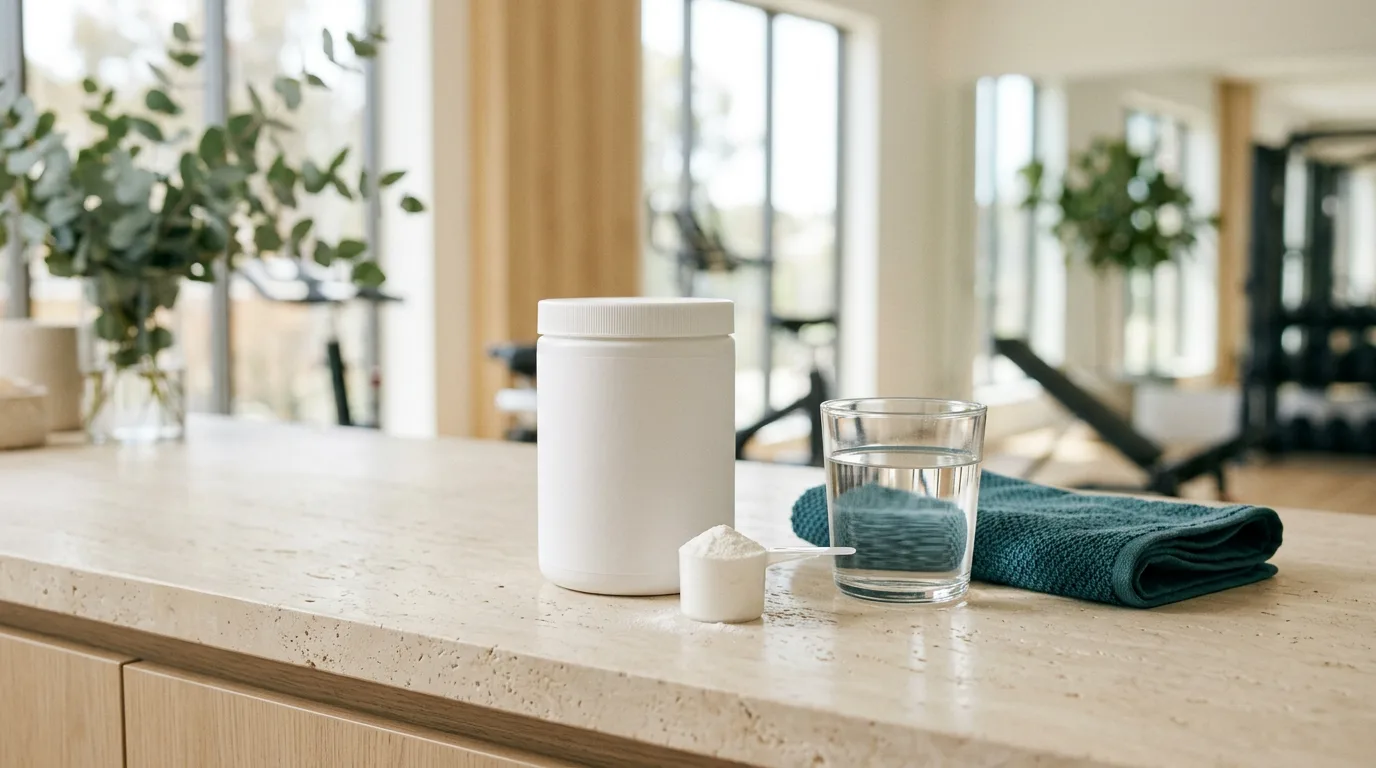
The supplement you'll see on the shelf is usually creatine monohydrate, a white powder you mix into a drink or food.
What does creatine do?
The AIS puts creatine monohydrate in its Group A list: supplements with strong scientific evidence for use in specific situations in sport. Here's what it says creatine can do:
- Help with strength training. Taking creatine while doing resistance exercise consistently improves strength, muscular endurance and muscle size, according to the AIS.
- Help with short bursts of hard effort. Creatine improves performance in brief, high-intensity exercise, usually under 30 seconds, especially when you repeat it, like in team sports.
The AIS also notes research on creatine and the brain, but that work is still developing, so it's interesting rather than settled.
What creatine won't do is build muscle on its own. It helps you get a bit more out of the training you're already doing. No training, no benefit.
Is creatine safe?
For healthy adults, the AIS says there's no evidence of systematic serious adverse effects from creatine monohydrate. Claims that it harms your muscles, kidneys or ability to handle heat aren't supported by research, it says.
There are a couple of things to know:
- You may put on 1 to 2 kg. Creatine draws water into your muscles, so the scales may go up a little. The AIS says this settles over 4 to 6 weeks if you stop.
- Some people get an upset tummy. The AIS describes this as mild and temporary, and not widely reported. Taking creatine with meals can help.
The general healthdirect advice on supplements applies here too. Talk to your GP or pharmacist before you start any supplement, because supplements can still cause side effects or interact with medicines. If you live with a kidney condition, take regular medicines or are pregnant, that conversation matters even more.
The Australian Institute of Sport describes a maintenance amount of about 3 to 5 g a day of creatine monohydrate. Check with your GP, pharmacist or an Accredited Sports Dietitian before starting.
Do you need creatine to build strength in midlife?
No. The foundations come first: regular strength training, enough protein and good sleep. Australia's physical activity guidelines suggest muscle-strengthening activities on at least two days a week, and the Thrive pieces on strength training for women and how much protein you need as you get older are good places to start.
If you're already training regularly and want to know whether creatine could add something, that's a good question to take to your GP or a sports dietitian.
How Thrive helps you keep track
What Thrive doesn't do. The Thrive Health Band doesn't measure creatine or what's in your muscles. It tracks the training and recovery around it, right across your health.
Log your strength sessions. Start a Strength workout in the app, log your sets and reps, and look back over your history to see the weights creep up. See calisthenics for beginners for sessions you can do at home.
Keep your supplements in one place. If you and your GP decide creatine suits you, add it in Medications & Supplements with the amount, how often you take it and the date you started, next to your morning tablets and anything else you take. You can show your Thrive trends to your GP. See keeping track of your medications.
See your recovery. The Band has no screen and up to 14 days of battery, so you can wear it day and night. Your Recovery Estimate shows how ready you are for another full day, and Thrive shows your sleep and resting heart rate over weeks, not just today.
Check your protein. Log meals by searching Australian foods or scanning a barcode, and see your daily protein next to calories, carbs and fat.
Then ask Ask Thrive questions like:
- "How many strength sessions did I do this month compared with last month?"
- "How has my resting heart rate looked since I started training three times a week?"
- "On days I logged a strength session, how much protein did I eat?"
Before you buy
- Thrive Health Band: A$589 for the band including 12 months of the Thrive plan, paid upfront. Prices are in AUD and include GST.
- Free shipping. Your 12 months start when you activate your Band, and there's no automatic renewal.
- One size, IP68, up to 14 days battery, 12-month warranty, no Apple Health sync. The app is Thrive by Optihealth on iPhone and Android.
- See today's price on the Thrive store
At renewal: a new band plus 12 more months for A$589.
Or keep your band and renew the plan for A$240 a year.
Or A$29 a month with no lock-in.
Consumer guarantees under Australian Consumer Law always apply. See Returns if something is wrong with your purchase.
Common questions
Is creatine safe to take every day?
For healthy adults, the AIS says there's no evidence of systematic serious adverse effects from creatine monohydrate. Check with your GP or pharmacist before you start, especially if you take medicines or have a health condition.
Does creatine make you put on weight?
It can, by about 1 to 2 kg, because creatine draws water into your muscles. The AIS says this goes back down over 4 to 6 weeks if you stop.
Can women take creatine?
The AIS guidance on creatine doesn't split its advice by sex. As with any supplement, talk to your GP or pharmacist first, and more so if you're pregnant.
For more answers, see Questions.