
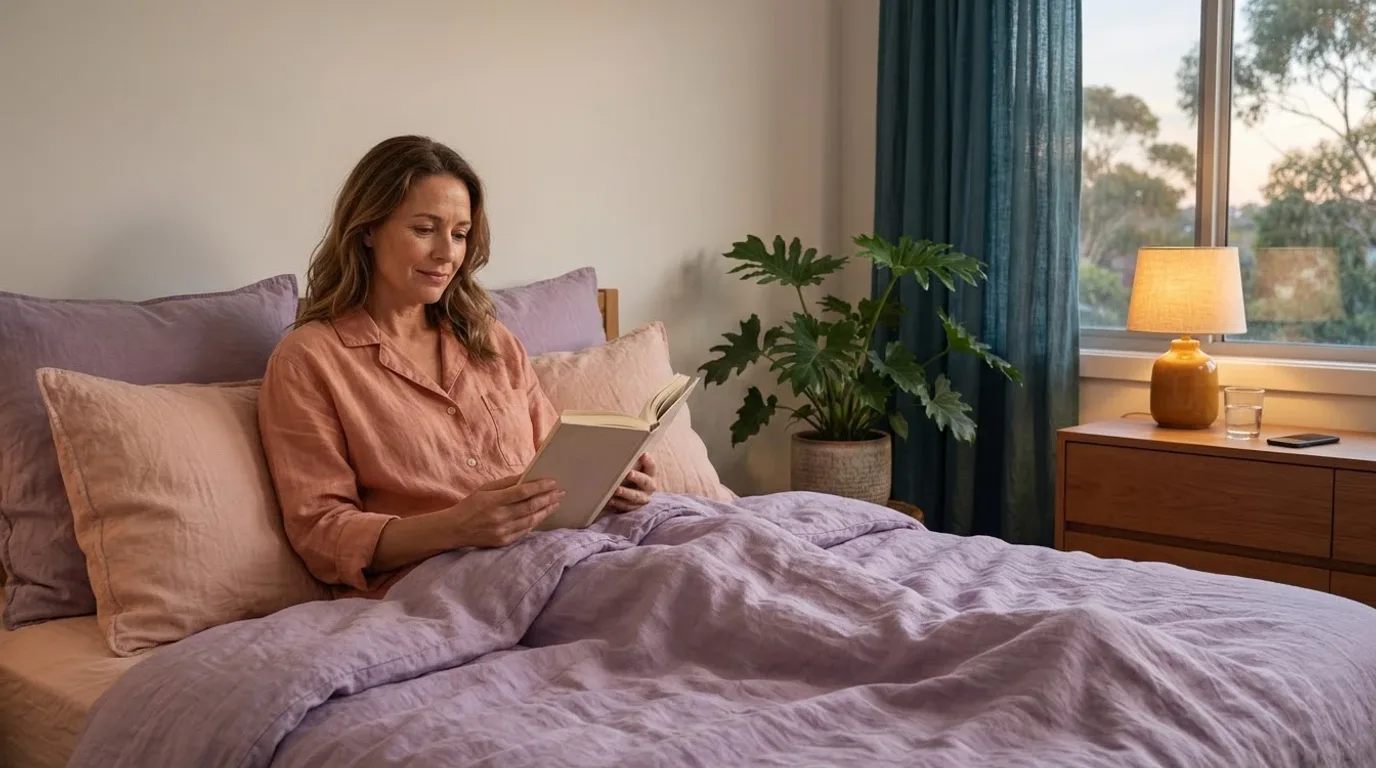
Lying awake with a busy mind? Sleep anxiety, late-night scrolling and gentle ways to wind down
Direct answer
If your mind switches on just as the lights go off, you are in good company. Worry, stress and a bright screen in your hand are a common mix at bedtime, and plenty of Australians say they get in the way of sleep. There is no single trick, but healthdirect's advice is a sensible place to start: keep a regular sleep pattern, keep screens out of the bedroom and switch them off for an hour before bed, deal with worries earlier in the day, and try a relaxation technique such as breathing exercises.
The Thrive Health Band has no screen, so there is nothing on your wrist to check at 2am. Afterwards, the Thrive by Optihealth app can help you see whether your quieter, screen-light evenings line up with calmer days and better nights, for you. Thrive does not diagnose, and none of this replaces a chat with your GP if sleep is a struggle.
What Australians say about sleep, anxiety and screens
Sheet Society, an Australian bedding company, published its 2026 Rest Report after hearing from more than 4,000 Australians. It is a survey from a bedding brand, not a clinical study, and the answers are self-reported. So treat the numbers as a snapshot of how people say they feel, not proof of what causes what. With that in mind, here is what it found:
- 67% of Australians said anxiety affects their sleep, and 66% pointed to stress.
- 61% of 18 to 24-year-olds said screen time or doomscrolling disrupts their sleep, compared with 40% of Australians aged 55 and over.
- 80% of people living alone said they struggle to switch off mentally at night, the highest of any household type in the survey.
- 58% said poor sleep makes them less patient, and 60% reported a hit to their mood and concentration.
- 27% said they use sleep-tracking technology.
None of that will surprise anyone who has stared at the ceiling at 1am. It is also a reminder that plenty of other people are lying awake with you, and that it is worth going gently.
Why the busy mind turns up at bedtime
"Sleep anxiety" is a phrase people use for worry about sleep itself, or for anxious thoughts that show up at night. It is not a diagnosis. healthdirect lists worrying about sleeping among the daytime effects of insomnia, and says short-term sleep trouble can happen when you are worried or stressed. It also lists anxiety, work or money stress, relationship issues and grief among the things that can make it worse.
Most Australians have trouble sleeping at some point. healthdirect says more than 1 in 10 people have at least mild insomnia at any given time.
Evenings are often when the day finally goes quiet. The thoughts you were too busy to look at at 2pm get loud at 11pm, and a phone is an easy way to keep them at bay for a little longer. Doomscrolling, which means scrolling through stressful news and posts long after you meant to stop, can feel like a way to switch off. It can keep you switched on instead. If "just one more video" sounds familiar, our piece on revenge bedtime procrastination is for you.
Gentle ways to wind down
None of these are rules. Pick one or two that suit your week.
- Give your worries an earlier slot. healthdirect suggests managing anything that is worrying you earlier in the day, rather than at bedtime. Ten minutes after work to jot down what is on your mind, and one small next step for each, can take some of the pressure off the evening.
- Put the phone to bed somewhere else. healthdirect advises avoiding screens in the bedroom and not using them for one hour before bed. Charging your phone across the room, or in another room, makes the late scroll harder.
- Stop watching the clock. healthdirect suggests considering taking clocks out of the bedroom, so you do not keep checking the time.
- Make the room comfortable. Quiet, dark, and not too hot or too cold. Our guide to sleeping on warm nights has ideas for summer.
- Try a relaxation technique. healthdirect lists breathing exercises and muscle relaxation as things to try before sleep. Slow, steady breathing is an easy one to start with.
- If you cannot sleep, get up for a while. healthdirect suggests going to another room and doing something quiet, such as reading, until you feel tired, then trying again. Lying in bed frustrated can make the bed feel like the problem.
- Keep your days steady. Go to bed and get up at around the same times, limit caffeine to the morning, and cut back on alcohol. Here is more on how to fall asleep faster and sleep hygiene basics.
- Move during the day. healthdirect suggests regular exercise, but not in the evening.
If your body is tired but your mind is wired, our article on feeling tired but wired has more.
A note on tracking your sleep
For some people, checking a sleep score every morning adds to the worry rather than easing it. If that is you, you do not have to look daily. The Band has no screen, so there is no number waiting on your wrist, and you can open the app when you choose, whether that is once a week or once a fortnight. We talk more about this in sleepmaxxing and trying too hard to sleep.
How Thrive helps you keep track
The Thrive Health Band is Australian designed and engineered, and screen-free on purpose. Nothing buzzes or lights up on your wrist at night, and it keeps reading in the background while you sleep.
- Check in on your day. In the Daily Check-In, rate your mood and stress, check in on your energy, and tag your day. You can add your own factor too, such as "late scrolling" or "phone out of the bedroom".
- See the pattern. The Mind & Mood category brings mood, stress, energy, sleep and HRV together over time, so you can see whether your more anxious days sit alongside shorter or more restless nights.
- Set a gentle nudge. In the app, you can set a bedtime reminder 15, 30 or 45 minutes before your usual bedtime, and see how your sleep Timing and Regularity scores change over the following weeks.
- Try a two-week experiment. Use Experiments to try, say, phone charging outside the bedroom, then compare how your sleep, mood and energy respond.
- Ask Thrive. Try "Is my sleep different on nights I tag late scrolling?" or "How has my stress looked this month compared with my usual?"
Over time, Thrive builds your Health Fingerprint, a picture of what is usual for you right across your health, so you are comparing yourself with you, not with an influencer's night routine. A pattern in your own data is a clue, not a cause.
We never sell or share your health data. With Thrive Loops, you choose who sees it. You can revoke access any time. Health data, including Ask Thrive data, is stored and processed in Australia.
When to talk to your GP
healthdirect says it is a good idea to see your doctor if you are having trouble sleeping, or if you are having problems with your mood, feeling restless in bed, or waking up not feeling refreshed. It suggests keeping a sleep diary to share with your doctor or another health professional. It describes long-term insomnia as trouble falling asleep or staying asleep at least three nights a week for at least three months, affecting how you function during the day.
Thrive does not diagnose, but Ask Thrive can help you get ready by lining up a few weeks of your sleep, mood and stress check-ins, so you can say what has changed and when. If worry or low mood has hung around for more than a couple of weeks, or it is getting in the way of work or time with people you love, please talk with your GP. If you would like to talk to someone now, call Beyond Blue on 1300 22 4636, or Lifeline on 13 11 14, any time. If you or someone else is in immediate danger, call triple zero (000).
Before you buy
A$589 for the band plus 12 months of the Thrive Plan, then renew from A$240 a year. Nothing renews automatically. The Band is bought once and stays yours. Prices are in AUD and include GST. Free shipping. Your 12 months start when you activate your Band. The Thrive by Optihealth app is on iPhone and Android. Australian designed and engineered. Up to 14 days battery, IP68 / 5 ATM and a 12-month warranty.
At renewal: a new band plus 12 more months for A$589.
Or keep your band and renew from A$240 a year.
Or A$29 a month with no lock-in.
Or A$430 prepaid for 24 months on the plan page (a separate option, not part of the annual illustration).
See what Thrive includes. Consumer guarantees under Australian Consumer Law always apply. See Returns if something is wrong with your purchase.
Common questions
What is sleep anxiety?
It is a plain-language phrase for worry about sleep, or anxious thoughts that show up at night. It is not a diagnosis. If it is affecting your days, your GP is the right person to talk to.
Does doomscrolling affect sleep?
In the 2026 Rest Report, 61% of 18 to 24-year-olds said screen time or doomscrolling disrupts their sleep. It is a survey by a bedding company, so it shows what people say, not proof of cause. healthdirect advises keeping screens out of the bedroom and off for an hour before bed.
What can I do when I wake at 3am with racing thoughts?
healthdirect suggests getting up and doing something quiet, such as reading, in another room until you feel tired, then trying again. Try not to check the time. Breathing exercises can help too.
Will tracking my sleep make me more anxious?
For some people it can. You choose when to look. The Band has no screen, and you can check the app weekly instead of daily.
Can Thrive tell me if I have an anxiety or sleep disorder?
No. Thrive does not diagnose. It helps you keep a record and see patterns in your own information, so you can talk it through with your GP.
Sources
- Sheet Society: 2026 Rest Report (survey of more than 4,000 Australians by a bedding company)
- healthdirect: Insomnia
- Thrive: Revenge bedtime procrastination
- Thrive: How to fall asleep faster
- Thrive: Choosing a screen-free health wearable in Australia