
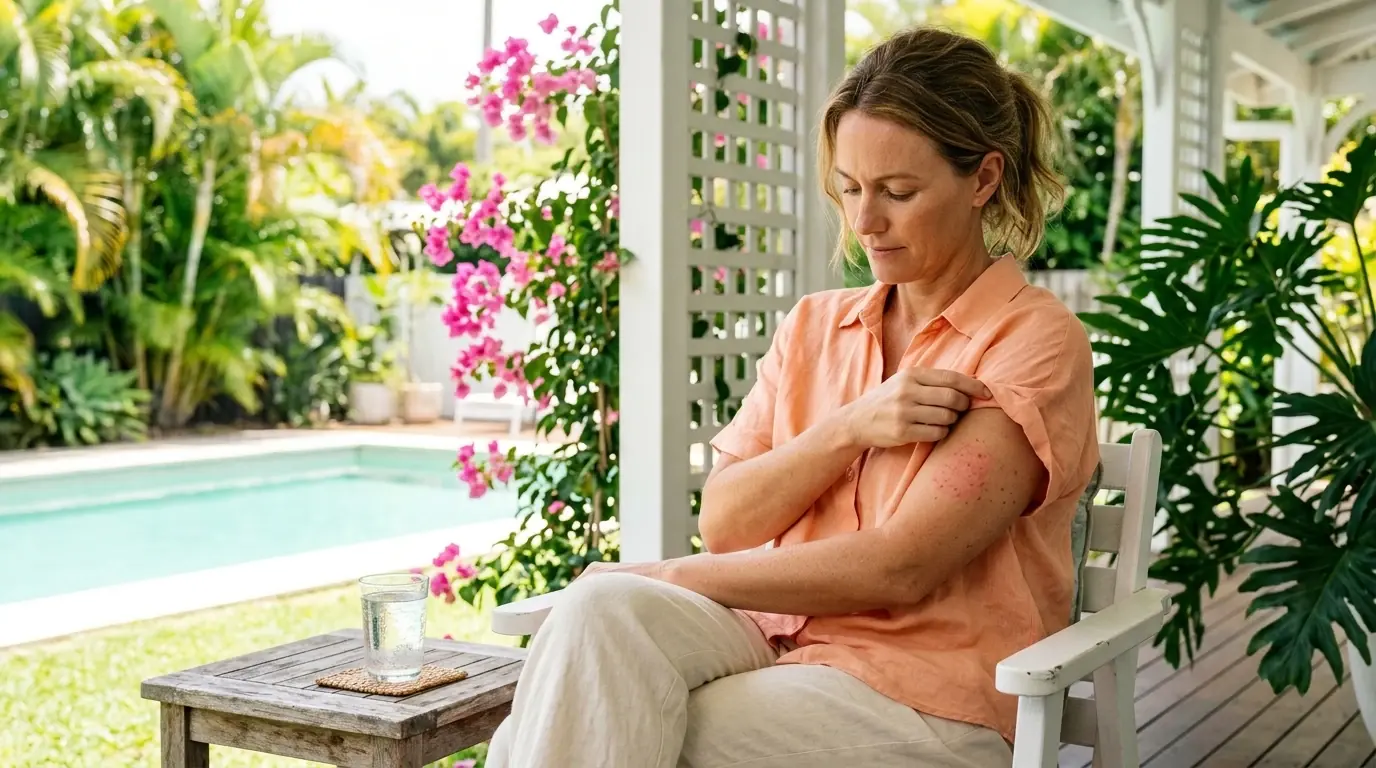
Heat rash and staying comfortable on hot, sticky days
Direct answer
Heat rash, also called prickly heat, sweat rash or miliaria, happens when sweat gets trapped under your skin. healthdirect says it is more common in babies and in people living in hot, humid weather, and that most heat rashes get better on their own if you keep cool and dry. See your doctor if the rash is severe, infected or keeps coming back.
Hot, sticky days are already here in parts of Australia, and the Bureau of Meteorology expects more through summer. The Thrive Health Band has no screen and keeps reading in the background, and the Thrive by Optihealth app can help you notice how hot days land on your sleep, your heart rate and how you feel. Thrive does not diagnose, and it cannot tell you whether a rash is heat rash. That is a question for your doctor or pharmacist.
Why the heat is on our minds
On 14 November 2026, ABC News reported that the Far North Queensland town of Weipa had reached 39 consecutive days above 36 degrees Celsius, and had recorded its highest-ever November temperature, 39.9C. Weipa baker Josh Lyon described the heat as "relentless". The Bureau of Meteorology's senior meteorologist David Crock said heatwaves are common at this time of year, but that one of this length over such a large part of the country is "quite notable".
Looking ahead, the Bureau's long-range forecast for November to January says temperatures are very likely to be above average for most of Australia, with an increased chance of unusually warm days and a very high chance of unusually warm nights. Hot, humid weather is exactly when heat rash is more likely.
What heat rash looks like
healthdirect says heat rash can look different depending on the type. You may notice:
- tiny clear blisters that break easily
- small red spots or bumps that may feel itchy
- deeper red or white lumps that feel prickly but are usually not itchy
It tends to appear where sweat collects, such as under your breasts or armpits, on your neck and upper chest, in skin folds, the groin and around your waist. In babies it can also appear on the face and in the nappy area.
What causes it
Heat rash happens when your sweat ducts, the tiny tubes that carry sweat to the skin surface, get blocked. The sweat cannot get out and builds up under the skin. healthdirect says you have a higher chance of developing it when you:
- are in hot and humid weather, such as during summer
- wear tight or heavy clothes that trap heat and moisture
- have a fever
- are sunburnt
Babies often get heat rash because their sweat glands are not fully developed, and a baby is more likely to get it if they are wrapped in too many layers.
What helps
healthdirect says heat rash usually gets better when your skin is kept cool and dry. Its self-care suggestions are:
- stay in a cool, well-ventilated place
- have cool baths, because good personal hygiene helps remove sweat and bacteria
- wear loose cotton clothing, and avoid tight or synthetic fabrics that trap heat and sweat
- use cornstarch or absorbent powders to keep your skin dry
- apply a gentle moisturiser if your skin is dry or itchy
If the rash is itchy or painful, ask your doctor or pharmacist about products that may help. healthdirect notes that some creams, such as calamine lotion, can cool and soothe itchy skin, and that stronger products need a doctor's advice.
When to see a doctor, and when it is urgent
See your doctor if the rash:
- does not get better after a few days in a cooler place
- covers a large area
- looks different from usual heat rash
- keeps coming back
Seek urgent care if you or your baby has signs of infection, such as lumps filled with pus, redness around the rash, or a high temperature. Also seek urgent care if there are signs of heatstroke. Heatstroke is a medical emergency, so call triple zero (000) and ask for an ambulance. Our heatwave guide explains the signs of heat exhaustion and heatstroke.
For advice any time, you can call the healthdirect helpline on 1800 022 222 to speak with a registered nurse.
Staying comfortable on hot, sticky days
Prevention is mostly about helping your body shed heat. healthdirect's advice is to keep cool to avoid sweating, avoid heat and humidity when you can, stay in air conditioning, near a fan or in a well-ventilated space, and wear loose cotton clothing. Beyond that, here is how to keep moving and sleeping through a humid week.
- Walks and runs. Go early in the morning or in the evening, when it is cooler, and choose shady routes. Slow down and go by effort rather than pace. Our guide to exercising in the heat explains how to adjust a workout.
- After you sweat. Change out of damp clothes, and have a cool bath or shower when you get home, so sweat is not sitting on your skin.
- Workouts. Move the hard session indoors, or swap it for a swim or an easy walk on the muggiest days.
- Warm nights. Keep the bedroom as cool as you can and wear light, loose cotton to bed. Our article on warm nights and summer sleep has more ideas.
- Look after your skin in the sun. Sunburn is on healthdirect's list of things that make heat rash more likely. Here is more on the UV index and summer walks.
- Drink water, especially if you are outdoors or active. If your doctor has asked you to limit fluids, ask them how much to drink in hot weather.
How Thrive helps you keep track
The Thrive Health Band is Australian designed and engineered, and screen-free on purpose, so you can wear it day and night through a hot week. Thrive is not a heat-safety device, and it does not tell you whether a room is too hot or whether you are unwell. What it can do is show you how hot days sit in your own picture.
- Record your walks and runs. The Band has no onboard GPS. To record a route, pace and distance in the app, take your phone along. For an early walk before the heat builds, that is an easy way to compare a cooler morning with a muggy one.
- Heart rate in the heat. In the app, see your heart rate and zones for each workout, so you can compare a hot morning with a cooler one at the same pace. Thrive also looks at how quickly your heart rate comes down after a workout.
- Sleep on warm nights. See how your sleep, overnight heart rate and recovery trends look when the bedroom stays warm.
- Log how you feel. In the Daily Check-In, rate your mood and stress, check in on your energy, and tag your day. Log Symptom lets you log how you feel and any symptoms, with a start and end time, so you can tell your doctor or pharmacist when something started and how long it has lasted.
- Ask Thrive. Try "How did I sleep during last week's heatwave?" or "How did my heart rate on my usual walk compare this week with last month?"
Over time, Thrive builds your Health Fingerprint, a picture of what is usual for you right across your health, so a hot spell stands out against a typical week for you. A pattern in your own data is a clue, not a cause.
We never sell or share your health data. With Thrive Loops, you choose who sees it. You can revoke access any time. Health data, including Ask Thrive data, is stored and processed in Australia.
When to talk to your GP
If a rash is not clearing, keeps coming back or just looks different from usual, talk with your GP or pharmacist. Thrive does not diagnose, but Ask Thrive can help you get ready by lining up when you logged symptoms, how you slept and how active you have been, so you can say what has changed and when. If you have a heart, kidney or other health condition, or take regular medicines, it is also worth asking your GP before summer how to manage very hot days.
If you or someone else shows signs of heatstroke, or you see signs of infection, do not wait. Call triple zero (000).
Before you buy
A$589 for the band plus 12 months of the Thrive Plan, then renew from A$240 a year. Nothing renews automatically. The Band is bought once and stays yours. Prices are in AUD and include GST. Free shipping. Your 12 months start when you activate your Band. The Thrive by Optihealth app is on iPhone and Android. Australian designed and engineered. Up to 14 days battery, IP68 / 5 ATM and a 12-month warranty.
At renewal: a new band plus 12 more months for A$589.
Or keep your band and renew from A$240 a year.
Or A$29 a month with no lock-in.
Or A$430 prepaid for 24 months on the plan page (a separate option, not part of the annual illustration).
See what Thrive includes. Consumer guarantees under Australian Consumer Law always apply. See Returns if something is wrong with your purchase.
Common questions
What is heat rash?
Heat rash, also called prickly heat or miliaria, happens when sweat ducts get blocked and sweat builds up under the skin. It is more common in hot, humid weather.
How long does heat rash last?
healthdirect says most heat rashes get better on their own if you keep cool and dry. See your doctor if it does not get better after a few days in a cooler place, covers a large area, looks different from usual or keeps coming back.
How can I help prevent heat rash?
Keep cool to avoid sweating, avoid heat and humidity where you can, stay near a fan or air conditioning, and wear loose cotton clothing, according to healthdirect.
Can Thrive tell me if I have heat rash?
No. Thrive does not diagnose, and it is not a heat-safety device. It can help you keep a record of how you feel and see how hot days line up with your own sleep and heart rate. For a rash, see your doctor or pharmacist.
Sources
- healthdirect: Heat rash
- ABC News: Cape York town of Weipa breaks weather records in prolonged heatwave (14 November 2026)
- Bureau of Meteorology: Long-range forecast: November 2026 to January 2027
- Thrive: Heatwave tips: how to look after yourself on very hot days
- Thrive: Warm nights and summer sleep
- Thrive: Choosing a screen-free health wearable in Australia